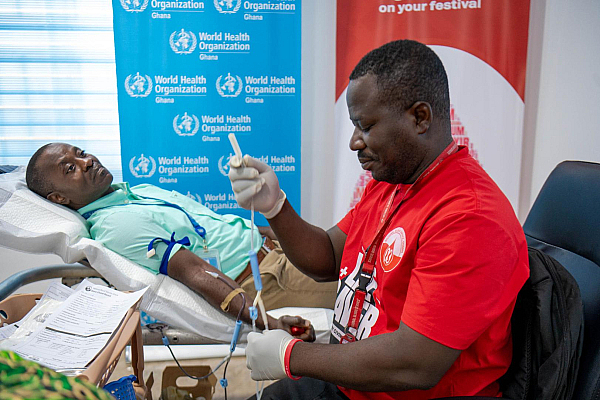
Blood donation is one of the simplest yet most powerful ways to save lives. Every unit of blood can help patients undergoing surgery, women experiencing complications during childbirth, accident victims, children with severe anaemia, and others in urgent need of transfusions.
Ghana National Blood Service has made good progress in coordinating the scale up of blood donations. In 2025, 204,000 units of blood were collected nationally. While this represents the rigorous efforts of our healthcare personnel and one of the service’s strongest performance in recent years, it falls short of the World Health Organization’s recommended annual requirement of 308,000 units for the nation representing donations from 1% of the population.
As part of its commitment to supporting Ghana’s national blood supply, WHO Ghana organized a voluntary blood donation exercise for staff at the Country Office in partnership with the National Blood Service.
The initiative forms part of WHO’s broader efforts to support Ghana’s blood bank and encourage regular voluntary blood donation. By donating blood, WHO staff demonstrated that strengthening health systems goes beyond policy and technical support, it also means taking practical action that can directly save lives.
Speaking during the exercise, WHO Representative to Ghana, Dr Fiona Braka, highlighted the lifesaving impact of donating blood.
« Every blood donation is an act of compassion that can mean the difference between life and death for someone in need. We are happy to have taken part of this exercise to save lives and strengthen Ghana’s health system ».
The National Blood Service welcomed the initiative, noting that voluntary blood donors are critical to ensuring a safe and reliable blood supply for patients across the country. The blood collected during the exercise will support people in need of emergency care, surgery, childbirth-related transfusions, cancer treatment, and other lifesaving medical interventions.
For many WHO Ghana staff, donating blood was an opportunity to make a meaningful difference.
« Donating blood only took a few minutes but knowing it could save someone’s life makes it one of the most meaningful things I’ve done today. I hope more people will make blood donation a regular practice because every unit of blood gives someone another chance at life », Dr Angela Ackon, Technical Officer for Integrated Service Delivery.
The exercise reflects WHO Ghana’s commitment to leading by example and encouraging a culture of voluntary blood donation, reminding everyone that a small act of generosity can give someone else the gift of life.
Distributed by APO Group on behalf of WHO Regional Office for Africa.
