In Ituri Province, still scarred by the consequences of armed violence and high unemployment, vocational training programs organized by the Bangladeshi contingent of the United Nations Organization Stabilization Mission in the Democratic Republic of the Congo (MONUSCO) are creating new opportunities for young people and helping transform lives.
Over the past several years, many young people across the province have acquired vocational skills and practical know-how that have enabled them to enter the job market in an environment where employment opportunities remain limited.
The training covers a wide range of fields, including heavy equipment operation, modern farming techniques, information technology, mechanics, electrical work, English language, mobile phone repair, refrigeration maintenance, and generator servicing, among others.
By teaching practical skills and promoting entrepreneurship, these initiatives provide many young people with a tangible alternative to idleness, poverty, and the risk of recruitment by armed groups.
« Opening new horizons »
For Ismael Issa Lema, a 35-year-old married father of eight, the opportunity proved life-changing.
« I encourage young people not to lose hope. Life is certainly very difficult, but there are various training opportunities organized here and there, particularly by MONUSCO, that open new horizons. That is exactly what happened to me. Thanks to a soap-making course I attended, I have become well known in Bunia and even as far as Drodro. People travel from the city to buy my soap because of its excellent quality, » he says proudly.
Formerly a farmer, Ismael was forced to abandon agriculture due to insecurity in his village of Walu, located about 40 kilometers from Bunia. Without stable employment and struggling to provide for his family, he turned to vocational training.
Before joining the MONUSCO program, Ismael had already attended several training courses in Beni, North Kivu Province, as well as online courses offered by an organization based in Benin. However, he believes it was at MONUSCO’s Ndoromo camp, on the outskirts of Bunia, where he acquired the skills that truly changed the course of his life.
« The training I had received before was quite basic and only taught me how to make bar soap. Through the MONUSCO training, I learned entrepreneurship and now I know how to produce liquid soap in addition to bar soap. This training expanded my skills and opened new opportunities for me. I had become discouraged after fleeing my village because of the war, with no idea how I would support my family, » he explains.
Today, from his small production unit in Bunia’s Kazunga neighborhood, Ismael prepares daily orders for customers from several parts of Ituri.
His story, however, is far from unique.
For the past seven years, hundreds of young women and men have participated in vocational training organized by MONUSCO’s Bangladeshi peacekeepers.
Preventing insecurity by creating opportunities
Beyond skills development, these training programs pursue several objectives: promoting the socio-economic integration of young people, reducing their vulnerability to recruitment by armed groups, and helping combat crime linked to unemployment and social exclusion. In a province where many young people struggle to find jobs, these initiatives offer practical responses to the socio-economic challenges that often fuel instability.
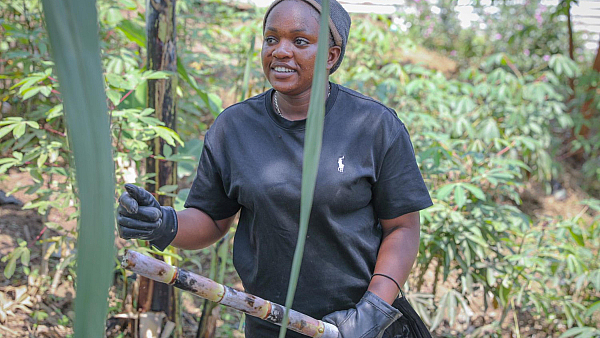
Among the beneficiaries is Sheylah Nyembo Saukira, a member of Ituri’s Youth Parliament and a Master’s student in Gender and Family Studies at the University of Goma. She celebrated her 23rd birthday on July 17 and has become a successful agricultural entrepreneur thanks to knowledge acquired during a MONUSCO training program.
Speaking from one of her farms in Bunia’s Police des Frontières neighborhood, she recalls how she once viewed agriculture.
« When I was a child, I thought farming was only for people who had never gone to school. As I grew older, I realized its importance and its ability to lift people out of poverty. During the MONUSCO training, we learned farming techniques, soil preparation, and cultivation methods for beans, cucumbers, maize, eggplants, and tomatoes. Before that training, I knew almost nothing about agriculture, » she explains.
Economic empowerment as a driver of change
The achievements of both Ismael and Sheylah demonstrate the tangible impact these training programs have on participants’ daily lives.
For Ismael, soap production has become a reliable source of income for his family.
« Every day, I produce one carton containing 25 bars of soap. My weekly turnover reaches about 125 US dollars, or nearly 500 dollars per month. Half of that is profit. This income allows me to send my children to school, pay for their healthcare, buy them clothes, and support my family, » he says.
The growth of his business has enabled him to purchase two motorcycles and a tricycle used to deliver his products.
Meanwhile, Sheylah now manages three farms: one in Bunia and two one-hectare farms near Komanda and Mambasa.
« The income from my harvests allows me to live comfortably. Depending on the season, I can earn 300,000 Congolese francs (about US$130), sometimes US$500 or even more from a single harvest. This enables me to finance my education, meet my personal needs as a young woman, and no longer depend financially on my parents. I have even opened a small grocery shop where I sell beverages, » she says with satisfaction.
Becoming role models for other young people
Drawing from their own experiences, both Ismael and Sheylah now encourage other young people to seize available training opportunities.
For Sheylah, agriculture offers particularly promising prospects.
« I encourage young people to take up farming. It is a promising sector that can quickly help people escape unemployment and poverty. Within just a few months, you can harvest, sell your produce, and earn an income. It is far better than remaining idle, which exposes young people to many dangers, » she emphasizes.
The Head of Ituri’s Provincial Youth and Patriotic Awareness Division, Jean-Bosco Uzele Upio, also praised the positive impact of these initiatives.
« The training programs organized by MONUSCO through its Bangladeshi contingent help strengthen the capacities of our young people so they can become productive members of society. Our youth should take advantage of this opportunity while it still exists. Since 2019, these peacekeepers have been providing free vocational training in various trades. This helps reduce unemployment and prevents some young people from joining armed groups, » he says.
The program’s impact often extends beyond its direct beneficiaries.
Thanks to the skills he acquired through MONUSCO, Ismael has himself become a trainer.
« Never lose hope, » he tells the young people of Ituri.
With MONUSCO’s support, he says he has already trained 125 other young people in soap-making, both in Bunia and in Drodro, in Djugu Territory.
Through stories like these, MONUSCO-supported vocational training programs demonstrate that investing in young people’s skills and economic empowerment can strengthen community resilience while contributing to peace and stability in Ituri.
Distributed by APO Group on behalf of Mission de l’Organisation des Nations unies en République démocratique du Congo (MONUSCO).
