With 401 terrorist incidents recorded in just five months, 448 vacant positions and nearly 600 million units of account in outstanding arrears, the figures reflect the scale of the financial and security crisis facing West Africa. To address these challenges, General Birame Diop is taking the helm of the ECOWAS Commission with a four-year action plan. From maintaining dialogue with the three countries of the Alliance of Sahel States to mobilizing 481 million dollars for the future counterterrorism brigade, the task ahead promises to be complex. The new leadership will have to turn these financial and security emergencies into tangible results for the population by 2027.
In Abuja, Nigeria, General Birame Diop has taken charge of the ECOWAS Commission with a four-year roadmap. His ambition: to strengthen regional integration, revive cooperation and bring the organization closer to the people. But the new president takes over a Community reduced to 12 member states following the departure of Burkina Faso, Mali and Niger. From dialogue with the Confederation of Sahel States to security, the proposed Eco currency and financing, the first months of his mandate will already be decisive.
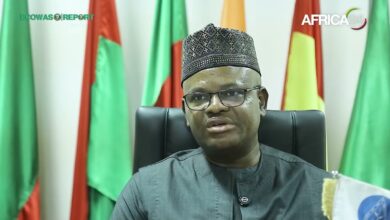
“The guidance we have received from the highest authorities is to respect the sovereign decision taken by the three countries, while continuing to keep the door open so that, together, we can explore and make use of every opportunity available to both sides to try to cooperate as closely as possible.”
Birame Diop, President of the ECOWAS Commission – Senegal
Security will be one of the main tests of his mandate. As armed groups expand and threats move closer to coastal countries, regional coordination remains a major challenge. Intelligence sharing, border control and cooperation among security forces are among the priorities. On the economic front, the Senegalese senior military officer and politician, Birame Diop, also wants to accelerate the free movement of people and goods. The aim is to facilitate trade and make regional policies more tangible for the population.
“There are many programmes. I looked at them, and there are more than 50 programmes that have already been designed and can be implemented. So, we must give ourselves the means to implement them. And ultimately, we must also take into account all the security pressures we are facing. This is extremely important.”
Birame Diop, President of the ECOWAS Commission – Senegal
More than 50 programmes are included in the ECOWAS Commission’s roadmap. Their implementation marks a new phase for the Commission led by General Birame Diop, who intends to strengthen the effectiveness of its institutions, consolidate cohesion among the 12 member states and diversify funding mechanisms. This momentum is part of the implementation of Vision 2050, whose first five years are now drawing to a close.
“So, to tackle all these challenges, which are clearly complex, we need a Commission that is committed, a Commission that stands together, a Commission that is moving in the same direction because it has developed a vision that provides it with a clear roadmap. If implemented thoughtfully, this roadmap could enable us to take on these challenges head-on and achieve results that may even exceed our expectations.”
Birame Diop, President of the ECOWAS Commission – Senegal
Six priorities, four years in office, and several major deadlines already on the horizon. By the end of 2026, General Birame Diop will notably have to advance dialogue with Burkina Faso, Mali and Niger, united within the Alliance of Sahel States, with a framework agreement expected in the fourth quarter. In 2027, the proposed Eco single currency and the 1,650-member counterterrorism brigade will have to reach a new stage. The force will require estimated annual funding of 481.46 million dollars. But the new leadership will also have to address 595.69 million units of account in outstanding community arrears and fill 448 vacant positions within the Commission. These financial and institutional challenges come on top of an already worrying security situation, with 401 terrorist incidents recorded between January and May 2026.